
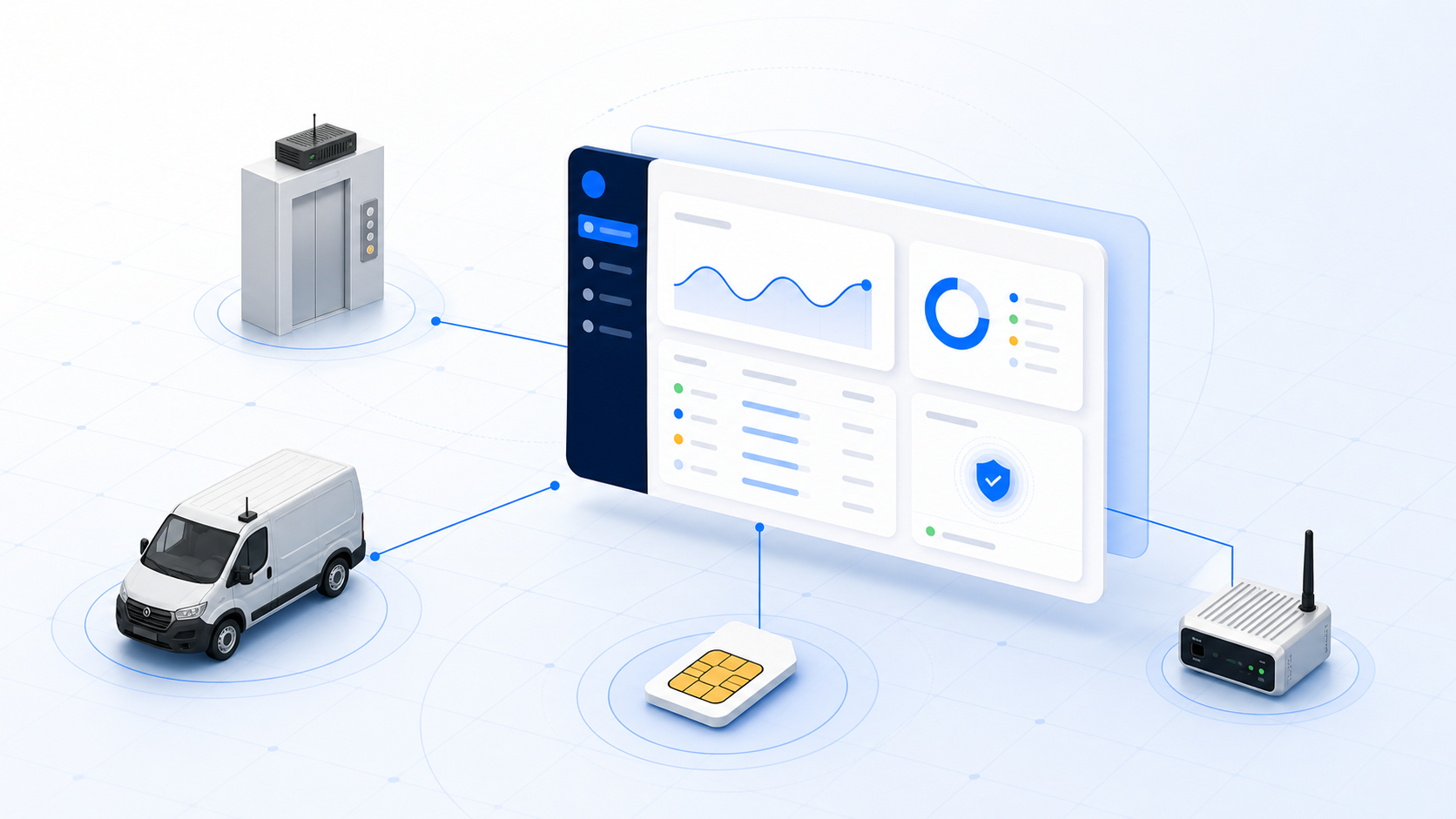
Connecting one device is easy. Operating hundreds of connected assets is a different job entirely. The SIM that worked during a desk test can become difficult to trace once it is installed in a vehicle, lift controller or remote gateway.
IoT SIM management is the process of keeping every connected service visible and controllable throughout its life: activation, assignment, monitoring, cost control, troubleshooting, suspension and retirement. For an operations team, the goal is simple: know which service belongs to which asset, whether it is behaving normally and what to do when it is not.
Start with the device lifecycle
Document how a SIM will be ordered, assigned, activated, monitored, paused and eventually retired. Record who may change each state and how changes will be audited.
A workable lifecycle is: receive and record the SIM; assign it to a customer, device and asset; apply the correct policy; activate it when the device is ready; monitor it in service; suspend it if the device is lost or faulty; and retire it when the asset leaves service.
Without that process, spare SIMs remain active, replacement devices lose their history and unfamiliar charges take far too long to explain.
Define groups before individual rules
A useful management model groups SIMs by customer, application, region or risk profile. Policies such as data limits and network settings can then be applied consistently.
Consider a field-services company with vehicle trackers, tablets and temporary site gateways. Putting all three into one default group would make reporting noisy and data limits unreliable. Separate groups let the business treat a low-usage tracker differently from a gateway that legitimately transfers larger files.
Provider documentation commonly distinguishes persistent group policy from one-off bulk changes. That is a useful design principle: use groups for rules that should continue to apply and bulk actions for a specific operational task.
Decide what normal usage looks like
Set an expected data range for each device type. A tracker, lift phone and video-enabled gateway have very different patterns. Useful controls may include per-SIM or group limits, threshold alerts and session-level usage records. Treat an alert as the start of a response workflow: who investigates, how quickly, and what can be changed safely?
Plan for troubleshooting
- Keep the SIM identifier, device identifier and asset record linked.
- Record recent network attachment and data sessions.
- Know whether a status change is immediate or asynchronous.
- Keep a tested path for temporarily disabling a lost or misbehaving device.
- Preserve the configuration needed to return an asset to service.
Check the commercial model
Compare more than the headline data rate. Ask about activation fees, monthly SIM charges, inactive-state charges, regional pricing, minimum terms and support. Model a realistic mix of active, spare and seasonal devices rather than assuming every SIM has the same monthly usage.
Before rollout, confirm device compatibility, coverage requirements, security controls, emergency-calling needs, data handling and escalation responsibilities. Capabilities vary by provider and plan, so verify each requirement in writing.
Questions to ask an IoT SIM provider
- Which SIM formats and device types are supported?
- What status, usage and session information can administrators see?
- Can policies be applied to groups as well as individual SIMs?
- How are unusual usage and service interruptions reported?
- What API, webhook and audit options are available?
- Which charges apply to active, suspended and spare SIMs?
- What happens when a deployed device cannot connect?
The answers should describe the service you are actually buying, not a generic platform demonstration.
Planning an Australian connected-asset deployment? Contact iSIM to discuss your device types, operating model and connectivity requirements.
Technical background: Telnyx IoT SIM documentation, SIM Card Groups and SIM Lifecycle. These sources describe general provider capabilities and do not confirm iSIM service inclusions.